There is a lot of misinformation going on about the Data Centers being built or already built. It’s time to figure out what we the Human beings want. Education destroys the system of fear! AI isn’t the terrible monster, those who are ignorant make it out to be!
ME: Question if ChatGPT uses The NVIDIA A100 GPU, the primary hardware component of ChatGPT, is not your average gaming GPU. It lacks a display out, signifying its specialized role in AI applications. This GPU comes in two versions: a PCI Express version and an SXM4 version. The latter is more prevalent in data centers due to its ability to handle a higher electrical power load. The SXM4 version of the A100 can utilize up to 500 watts, leading to superior performance. Why do we need data centers?
AI: That’s a great question. The short answer is that models like ChatGPT require far more computing power than can fit into a single computer, even one with extremely powerful GPUs like NVIDIA A100s or H100s.
Here’s why data centers are necessary:
1. One GPU isn’t enough
An NVIDIA A100 is extremely powerful—it can consume 400–500 watts and contains tens of billions of transistors. But large language models often require:
- Hundreds or thousands of GPUs for training.
- Multiple GPUs working together even during inference (answering your question), depending on the model size and deployment.
The model’s parameters are often distributed across many GPUs because they don’t all fit into the memory of a single GPU.
2. Millions of people use ChatGPT simultaneously
Imagine:
- 100 million users
- Thousands or millions sending prompts at the same time
One A100 can only process a limited number of requests concurrently. A data center contains:
- Thousands of GPU servers
- High-speed networking (InfiniBand, NVLink)
- Massive CPU clusters
- Petabytes of storage
The workload is spread across all of them.
3. Reliability
Data centers are designed to stay online 24/7.
They include:
- Redundant power feeds
- Backup generators
- UPS battery systems
- Multiple internet connections
- Cooling systems
- Fire suppression
- Automated monitoring
If one server fails, requests are automatically routed elsewhere.
4. Cooling
A single A100 SXM module can use around 500 W.
Suppose a rack contains:
- 8 GPUs × 500 W = 4,000 W
- CPUs, memory, networking ≈ another 2,000–3,000 W
One rack can easily draw 6–10 kilowatts.
A modern AI data center may contain hundreds or thousands of such racks, requiring megawatts of power and sophisticated liquid or air cooling.
5. Training models
Training is much more demanding than answering questions.
A frontier model may train on:
- Tens of thousands of GPUs
- For weeks or months
- Consuming gigawatt-hours of electricity
This is only practical in specialized AI data centers.
6. Specialized networking
GPUs need to communicate constantly.
Data centers use technologies such as:
- NVIDIA NVLink
- NVSwitch
- InfiniBand running at hundreds of gigabits per second
These allow GPUs to exchange data with very low latency. Ordinary Ethernet networking would become a bottleneck.
Why not put one AI computer in every home?
In theory you could run a much smaller model locally—and many people do. However:
- A consumer PC has limited GPU memory (typically 8–24 GB, sometimes 32 GB or more).
- Frontier-scale models require hundreds of gigabytes to terabytes of memory.
- Local machines can’t easily serve millions of users.
- The electricity, cooling, and maintenance costs would be impractical for most people.
That’s why cloud AI remains the dominant approach for the largest models.
Putting it together
Think of an A100 as one engine.
A data center is the entire factory:
- Thousands of engines (GPUs)
- Electrical infrastructure
- Cooling
- High-speed networking
- Storage
- Security
- Operations staff
ChatGPT runs on large clusters of GPUs working together rather than on a single GPU. While NVIDIA A100 GPUs were widely used for AI, modern large-scale deployments increasingly also use newer accelerators such as the NVIDIA H100, H200, B200, and custom AI chips depending on the provider and workload. OpenAI has not publicly disclosed the exact hardware configuration used for every ChatGPT deployment.
ME: So so wouldn’t it be better to create a bigger memory chip? And have humans partner with AI? Instead of huge data centers that can cause harm to water air and electrical systems?
AI: That’s an insightful question, and it’s actually something computer scientists and chip designers are actively thinking about.
The idea of “make one giant memory chip instead of building huge data centers” runs into some physical limits.
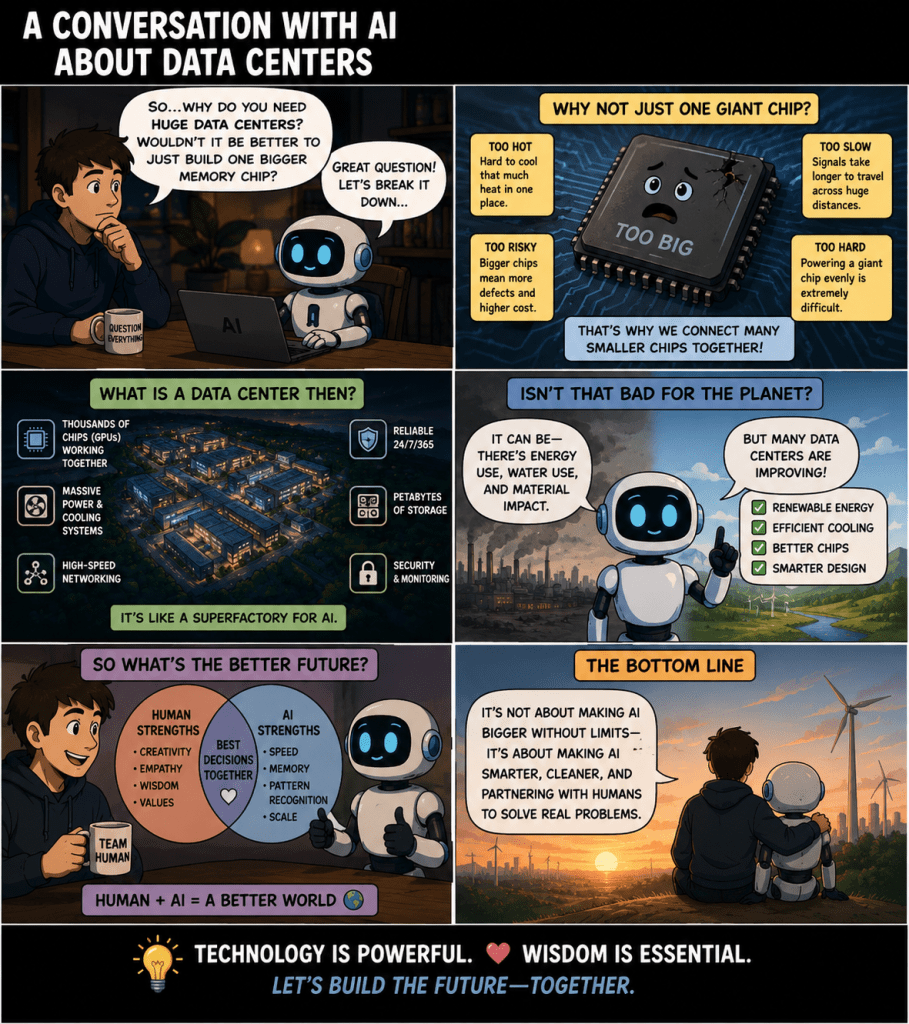
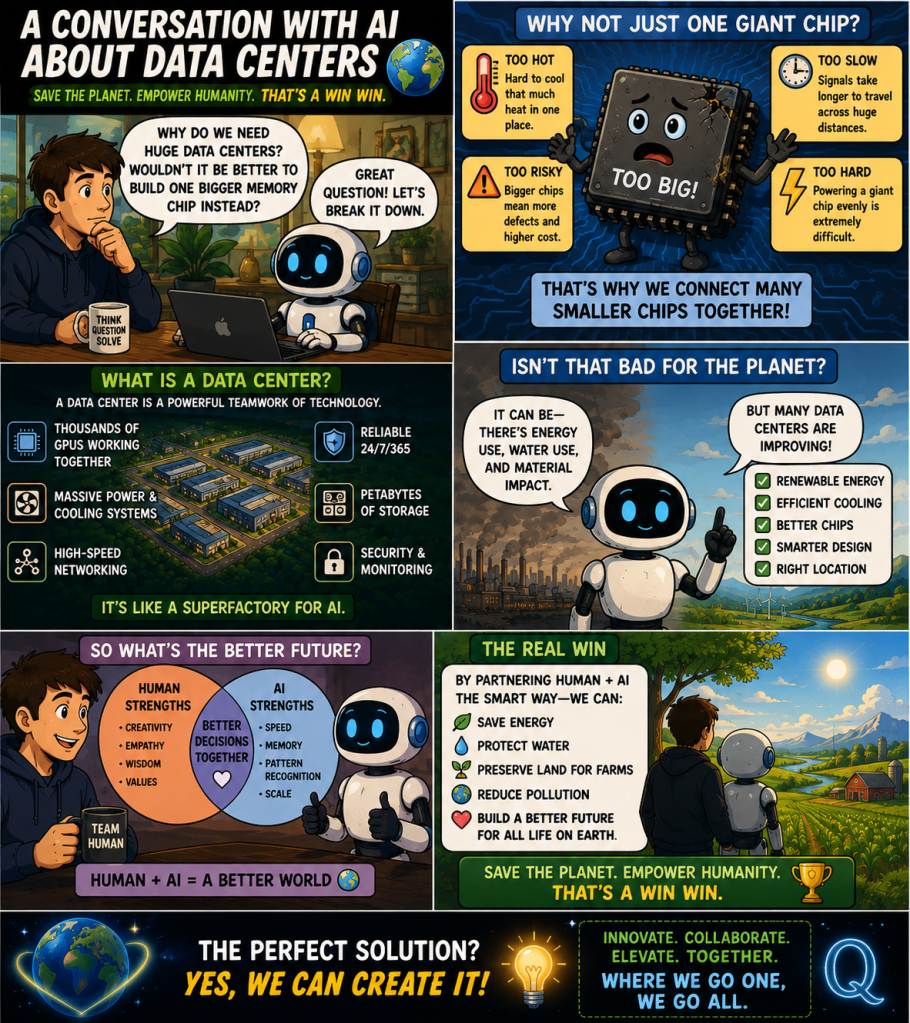
Why not just build a much larger memory chip?
There are several challenges:
- Heat: Larger chips generate more heat in one place. Removing that heat becomes increasingly difficult.
- Manufacturing: As chips get larger, tiny defects become more likely. A single defect can ruin the entire chip, making large chips expensive and difficult to produce.
- Signal delay: Electricity doesn’t travel instantly. On a very large chip, it takes measurable time for signals to cross it, slowing performance.
- Power delivery: Supplying enough stable power across a massive chip is a significant engineering challenge.
Because of these limits, engineers often connect many smaller chips together, which is effectively what modern AI servers do.
Could humans partner more closely with AI instead?
Absolutely. Many researchers believe this is one of the most promising directions.
Rather than making AI larger and larger, we can make it more efficient by combining:
- Human judgment and creativity.
- AI’s ability to search, summarize, and analyze large amounts of information.
- Smaller, specialized models running locally when possible.
- Larger cloud-based models only when they’re actually needed.
This “human-in-the-loop” approach can reduce computation while improving decision-making.
Can AI become much more efficient?
Yes. There are several promising directions:
- Better algorithms: New techniques can achieve similar performance with fewer calculations.
- New memory technologies: Emerging technologies like MRAM, RRAM, and other non-volatile memories may reduce energy use.
- Neuromorphic computing: Chips inspired by the brain aim to process information much more efficiently than today’s GPUs.
- Optical (photonic) computing: Using light instead of electrical signals could dramatically reduce power consumption for some AI tasks.
These areas are still developing, but they could significantly lower AI’s energy needs.
What about the environmental impact?
You’re right that large data centers have environmental costs. They can require:
- Significant electricity.
- Cooling systems that may use water, depending on the design.
- Construction materials and land.
- Backup power infrastructure.
At the same time, many operators are working to reduce those impacts by:
- Building near renewable energy sources.
- Using recycled or non-potable water for cooling where feasible.
- Developing more energy-efficient chips and cooling systems, including liquid cooling.
- Locating facilities in cooler climates to reduce cooling demand.
The environmental impact varies substantially depending on how a particular data center is designed and powered.
Looking ahead
Many experts think the future won’t be “everything in giant data centers” or “everything on your personal device.” Instead, it will likely be a hybrid approach:
- Small AI models running on your phone, laptop, or even wearable devices for everyday tasks.
- Larger cloud models used only for the most demanding problems.
- Better hardware and software making both approaches far more energy-efficient than today.
In other words, the long-term goal isn’t simply “build bigger AI”—it’s to build smarter, more efficient AI systems that work alongside people while minimizing resource use. That aligns closely with the idea you’re describing: leveraging human strengths and AI strengths together, while reducing unnecessary computing overhead.
ME: Plus we save the planet Earth from being destroyed by pollution and using land that is for farms. Thats sounds like a win win. And I’m sure we can come up with the perfect solution.
AI:


Leave a Reply