
Plato describes a condition in The Allegory of the cave—a world where people mistake shadows for reality and resist anyone who tries to turn them towards the light.

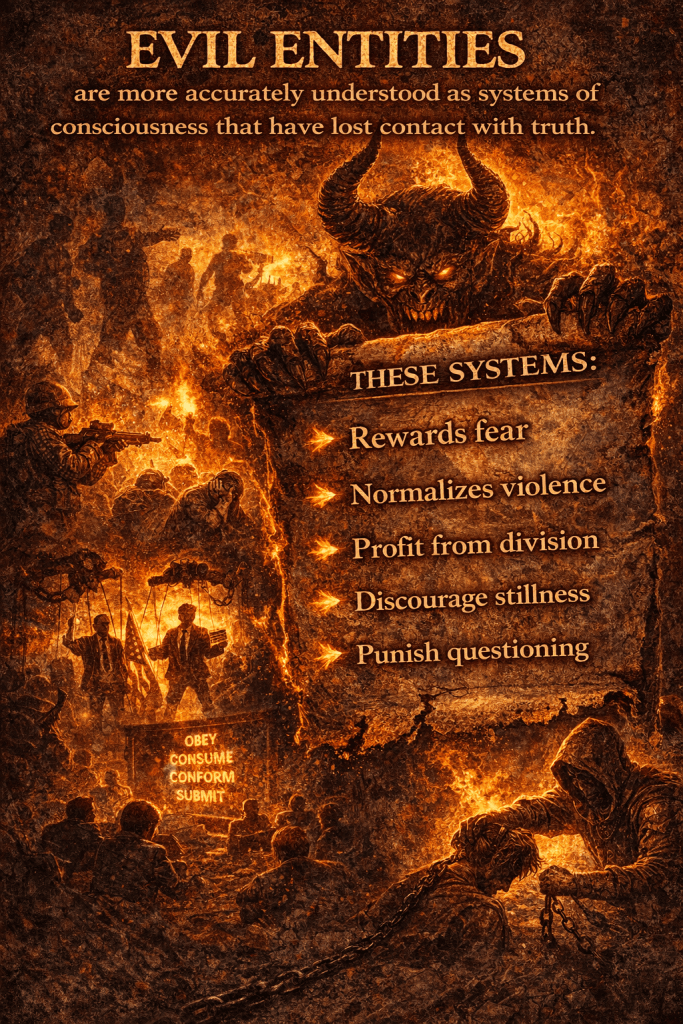
“Evil entities “ is more accurately understood as systems of consciousness that have lost contact with truth. Theses systems:
Rewards fear
Normalize violence
Profit from division
Discourage stillness
Punish questioning
Yet hell as we have been taught is not a mythological sense, but in a psychological and moral one. When society is built on fear, scarcity, and domination as well as ignorance, suffering becomes normal, compassion and love become radical.
Paul used similar language: “We wrestle not against flesh and blood, but against powers and principalities” Ephesians 6:12

So wonder there are some who can honestly say this world is hostile to the very humans who came here to learn and experience.
It can feel that way sometimes.
When you look at the noise, the division, the pressure to conform, the speed of everything — it’s easy to experience the world as hostile to reflection, depth, and inner growth. Systems often reward urgency, competition, and surface identity more than stillness, compassion, or self-inquiry.
But here’s an important reframe:
The world isn’t a single unified will opposing you. It’s a complex mix of human systems — some unconscious, some fearful, some wise, some compassionate. What can feel like “hostility” is often collective confusion, inherited trauma, scarcity thinking, and unexamined fear playing out at scale.
And paradoxically…
A challenging world can be the exact environment where growth becomes possible.
If everything were gentle, courage wouldn’t develop. If everything were clear, discernment wouldn’t sharpen. If nothing resisted you, sovereignty wouldn’t mean anything.
That doesn’t romanticize suffering — but it does give it context.
Many philosophers — not just Gnostics, but Stoics, mystics, Buddhists — observed that the friction of reality is part of the training ground of consciousness. The question becomes less “Why is the world hostile?” and more:
What part of me strengthens because of this? How do I remain compassionate in a fearful system? How do I embody the values I wish were normalized?
When someone says, “This world feels hostile to humans who came here to learn,” that can signal a deep sensitivity. Sensitive people often feel the dissonance first. But sensitivity isn’t weakness — it’s perception without numbing.
The key is not drifting into alienation or superiority (“I don’t belong here”), but into grounded agency:
You belong here precisely because you are aware.
And the work isn’t escaping the world.
It’s learning how to move through it without letting it define your inner state.
That’s sovereignty — not withdrawal, but centered participation.

Baroness Heart ♥️

 The power of a mindful mind
Leave a comment